Executive Summary
Many engineering teams successfully build impressive AI agent POCs in just a few days. However, once deployed to production with real users, these systems often suffer from instability, redundant API calls, and context drift. Attempting to resolve these issues solely through prompt engineering or expanding the context window quickly hits hard engineering limits.
In this article, we analyze the architectural challenges of transitioning to production and demonstrate how combining graph theory, deterministic state management, and standardized communication protocols enables the construction of scalable and reliable agentic systems.
1. Case Study: Partial Failure, Recovery, and Idempotency
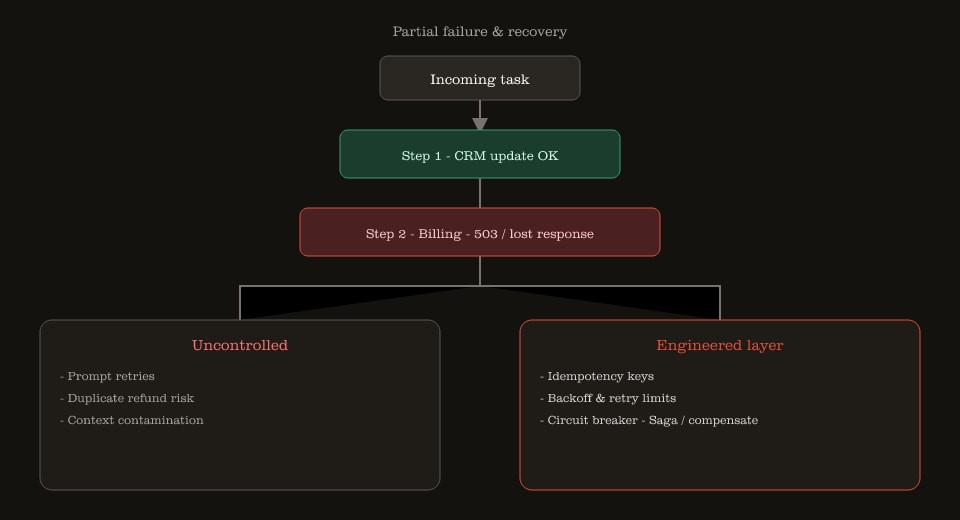
Consider a common operational scenario involving a two-step complex task:
- Task: "Update the customer's shipping address and issue a refund for shipping fees."
- Step 1: The agent successfully calls the CRM API and updates the address.
- Step 2 (Failure): The agent attempts to call the Billing API, but the external server returns a temporary error (
503 Service Unavailable), or the refund executes successfully but the response is lost in transit.
The Engineering Solution: Multi-Layer Control
To ensure stability during partial failures, the architecture must decouple the model’s reasoning from server-side execution rules:
- Double-Execution Protection: A
503 Service Unavailableerror or lost network response does not prove that the action failed on the server side. Therefore, retrying the call without a dedicated control mechanism is unsafe. Every non-idempotent action should be protected against duplicate execution using mechanisms like a stable Idempotency Key across retries (when supported by the receiving API). If the API lacks native idempotency support, state checks or reconciliation workflows are required before initiating a new transaction. - Intermediate State & Compensating Transactions: Once Step 1 completes and Step 2 fails permanently, the system persists the state in a defined intermediate status. The recovery strategy depends on domain logic: in some cases, keeping the updated address while queuing the refund for asynchronous or human resolution is preferred; in others, a compensating transaction (such as reverting the address update via a Saga Pattern) is required.
- Exponential Backoff & Retry Limit: Retries are bounded by explicit limits and backoff logic, managed entirely outside the model's context window.
- Circuit Breaker: If the Billing service fails repeatedly, a Circuit Breaker opens to temporarily halt further requests, preventing cascading failures.
2. Four Architectural Pillars: Trade-off Analysis
A. Information Retrieval: Vector Search vs. GraphRAG
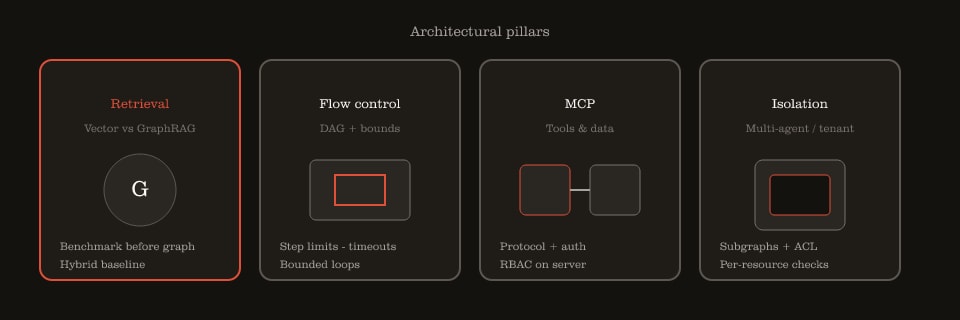
- Vector Search: Excellent, fast, and cost-effective for semantic similarity retrieval. However, it struggles with global, corpus-wide queries requiring cross-entity relationship mapping or hierarchical synthesis.
- GraphRAG: Utilizing Knowledge Graphs may improve retrieval effectiveness for queries requiring complex cross-entity mapping or summarizing themes across large document collections.
- Engineering Trade-off: GraphRAG is not a drop-in replacement for vector search. It introduces higher indexing, graph construction, and maintenance costs. Recommendation: Benchmark GraphRAG against a hybrid/vector baseline on a representative evaluation dataset before committing to a graph architecture.
B. Execution Control: DAGs and Flow Constraints
- Bounding Execution Paths: Modeling execution flows as Directed Acyclic Graphs (DAGs) helps constrain execution order and reduce unexpected execution paths.
- Architectural Caveat: A DAG alone does not guarantee system-wide loop prevention (e.g., outer wrappers or external triggers can re-invoke execution). True determinism requires explicit step limits, timeouts, and bounded retry handlers. In iterative processes, bounded loops with explicit exit conditions should be enforced.
C. Tools & Communication: Model Context Protocol (MCP)
- Standardized Interfaces: The Model Context Protocol (MCP) provides a standardized specification for connecting AI applications (Hosts) to external tools and data sources (Servers), improving modularity and decoupling architecture.
- Protocol vs. Security Controls: MCP defines the *communication interface* but does not inherently enforce authorization or data isolation. System security remains dependent on underlying authentication mechanisms, RBAC, token management, and server-side Prompt Injection controls.
D. Context Isolation
- The Risk: In multi-agent or multi-tenant environments, context contamination can lead to sensitive data leakage or state corruption across sessions.
- In-Depth Solution: Subgraph memory partitioning is useful but insufficient. Hard server-side access controls must validate user permissions against each resource before injecting data into the model context.
3. Production Evaluation Metrics
To evaluate system reliability beyond ad-hoc testing, observability pipelines should track the following quantitative metrics:
| Metric | Measurement Approach |
|---|---|
| Task Success Rate | Percentage of tasks fully completed against predefined criteria on a test benchmark. |
| Output Correctness & Quality | Percentage of actions verified as domain-correct (not merely error-free execution). |
| Tool Failure Rate | Rate of failed tool calls, separated by transient (5xx) vs. permanent (4xx) errors. |
| Retry & Recovery Rate | Percentage of calls requiring retries, and the rate of unassisted automated recovery. |
| Cost per Successful Task | Total operational cost (model tokens, infrastructure, API calls) divided by successful tasks. |
| Latency Profile | Median and high-percentile execution durations (P50, P95, P99). |
4. References & Further Reading
- Model Context Protocol (MCP) Specification & Security Considerations: https://modelcontextprotocol.io/specification and https://modelcontextprotocol.io/docs/concepts/security
- From Local to Global GraphRAG (Microsoft Research): https://arxiv.org/abs/2404.16130
Conclusion: Reliability Is an Architectural Property
Moving AI agents to production is not simply a matter of refining prompts or selecting a larger model. Reliable systems require explicit state management, bounded execution, controlled tool access, failure recovery, and measurable evaluation.
Architectural patterns such as GraphRAG, state machines, and protocols like MCP address specific technical challenges, but none is a universal silver bullet. The optimal design depends on task requirements, risk profile, and empirical data gathered from production-like evaluations.
For engineering teams, the goal is not to eliminate model non-determinism entirely, but to build an architecture that bounds uncertainty, detects failure early, recovers safely, and maintains sufficient observability.